On 6 October 2026, India’s National Medical Commission (NMC) released a new set of rules that changes how doctors, clinics and hospitals can promote themselves. The rules came into force the same day, with no grace period.
If you have ever scrolled past a “Best Knee Surgeon in the City” reel, a glowing patient video on a hospital’s Instagram page, or a “50% off on full-body check-up” offer, this news affects exactly that kind of content. Whether you are a doctor, a hospital administrator, a marketer or simply a patient, here is a plain-language guide to what has changed and why it matters.
First, what is the NMC?
The National Medical Commission is the body that regulates medical education and medical practice in India. It replaced the old Medical Council of India in 2020 under the NMC Act, 2019. Every practising doctor in the country is registered either with a State Medical Council or on the National Medical Register, and the NMC sets the ethical code they are expected to follow.
Why were these guidelines needed?
Doctors in India have been barred from self-promotional advertising for a long time under the 2002 Professional Conduct regulations. But those rules were written before Instagram reels, paid Google rankings, influencer collaborations and AI-generated videos existed. Hospitals, in particular, often operated in a grey zone, running aggressive campaigns that individual doctors could not.
The NMC tried to update the rules in August 2023, but those regulations were put on hold after strong pushback from the Indian Medical Association. The new document, officially titled the Guidelines on Ethical Advertising and Public Communication by Hospitals/Medical Institutions and Registered Medical Practitioners, was issued by the NMC’s Ethics and Medical Registration Board. It was framed against the backdrop of a pending Supreme Court case on the subject.
The stated goal is simple: healthcare communication should be truthful, factual and evidence-based, so that patients choose care on reliable information rather than marketing pressure.
What counts as “advertising” now?
This is the most important thing to understand, because the definition is far wider than most people expect. Under the new guidelines, advertising is any communication that directly or indirectly promotes a doctor’s or hospital’s services, reputation, qualifications, achievements or facilities.
That covers the obvious formats like newspaper ads, hoardings, TV and radio. But it also explicitly covers websites, social media posts, WhatsApp and other messaging platforms, podcasts, sponsored and targeted posts, search engine promotion, listings on online healthcare platforms, influencer campaigns and AI-generated content. In short, if a piece of content is designed to bring patients in, the NMC treats it as an advertisement, regardless of where it appears.
What is no longer allowed?
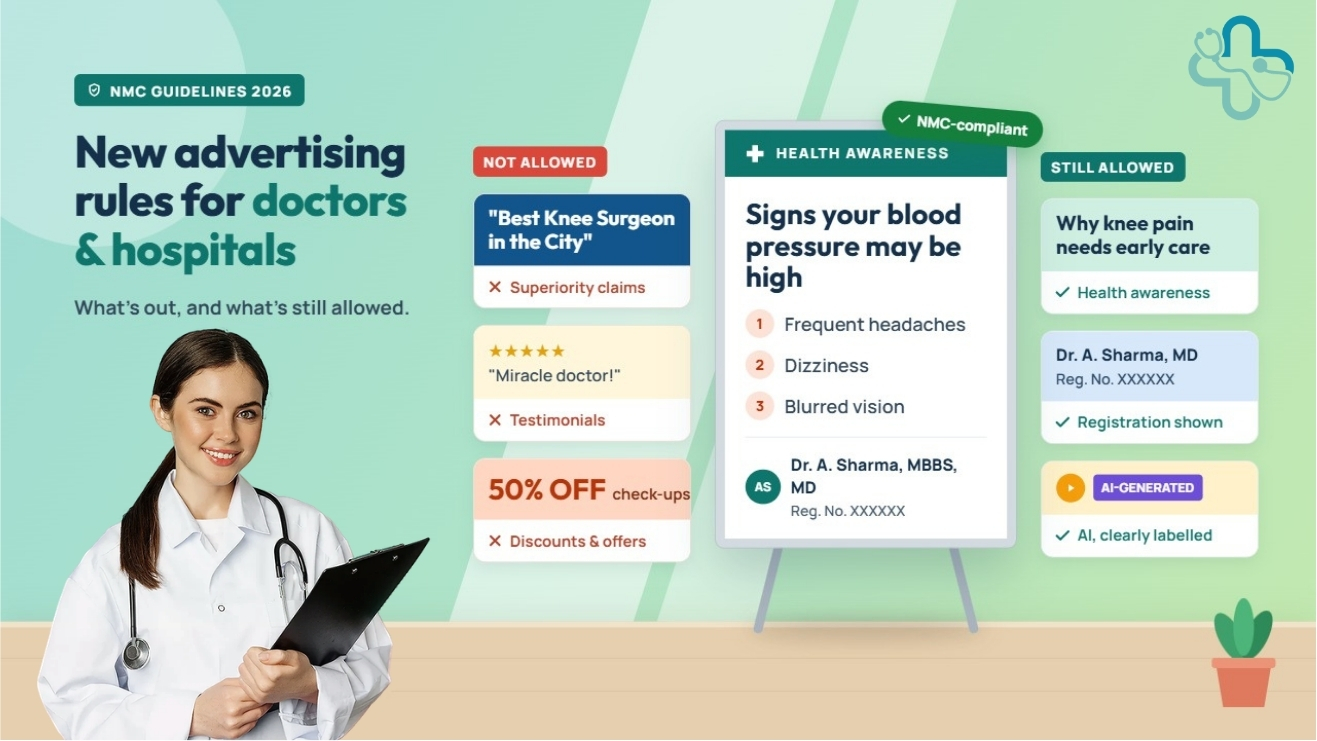
The biggest change is around patient testimonials and reviews. Doctors can no longer ask patients for testimonials or share them on social media to promote their practice. Nobody, whether a doctor or a hospital, may buy, solicit, manipulate or publish fake or paid reviews and ratings. The NMC has also barred paid rankings on healthcare platforms, the kind where a clinic pays to appear at the top of a “top doctors near you” list.
Next come exaggerated claims. Phrases like “best doctor”, “No. 1 hospital” or “100% success rate” are out, as is any suggestion of a guaranteed result or superiority over other practitioners. The thinking is that such claims give patients unrealistic expectations and can push them towards tests or procedures they do not need.
Before-and-after photos and patient stories are also heavily restricted. Importantly, getting the patient’s consent does not make an otherwise prohibited testimonial or before-and-after post acceptable. Where patient material can legally be used, consent must be specific, informed and documented, and identifying details should be blurred or cropped out.
Discounts and freebies are another casualty. Limited-period offers, coupons, gift packages and referral rewards are not permitted, because they encourage people to book consultations they may not need.
Doctors also cannot use their own photographs for self-promotion, for example on promotional posts, letterheads or clinic signboards used as publicity. Celebrity and influencer endorsements of medical services are restricted, and doctors cannot pay influencers, agencies or platforms in any arrangement linked to bringing in patients. Finally, live broadcasts of surgeries for commercial purposes are not allowed unless they follow NMC norms.
The new rules on AI-generated content
This is one of the first Indian medical regulations to deal directly with artificial intelligence, and it arrives at the right time. Over the past year, many clinics and hospitals have posted AI-made videos featuring digital versions of their doctors, or AI “patients” describing how wonderful their treatment was.
The NMC has now said that AI-generated promotional campaigns meant to serve commercial interests are prohibited. AI cannot be used to fabricate patient experiences, voices, testimonials, clinical results or endorsements, or to make a treatment look more effective than it really is. Where AI content is used in a way that complies with the rules, it must carry a clear disclosure stating that it was generated by AI.
The principle is easy to remember: if a viewer could be misled into thinking something artificial is real, it should not be used to promote healthcare.
So what can doctors and hospitals still do?
It would be a mistake to read these guidelines as a ban on doctors being online. They are not. The NMC has made it clear that social media can still be used, as long as the purpose is education rather than patient acquisition.
Doctors can create health-awareness content, take part in public health campaigns, give talks and join academic discussions. The condition is that this content should not promote their personal practice, should not solicit patients and should not be monetised through promotional marketing. Sharing case studies published in reputed medical journals is also permitted.
Hospitals can share factual information about their infrastructure, facilities, equipment, technology and diagnostic services, provided they avoid claims of superiority or guaranteed outcomes. Billboards are allowed for this kind of factual information. A hospital website can also list its doctors with their names, qualifications, specialties, registration details and availability, since that serves patients rather than advertising to them.
There is one new requirement that applies to almost everyone posting online. When doctors publish on electronic media, they must show their name, qualifications, registration status and State or National Medical Register number. Clinics and hospitals must disclose the same details for the doctors featured in their posts.
“My agency handles it” is no longer an excuse
Most doctors and hospitals do not run their own social media. They hire an agency, a freelancer or an influencer. The NMC has anticipated this. Outsourcing your marketing does not shift the responsibility away from you.
If a doctor or hospital authorised, commissioned, sponsored, adopted or knowingly allowed a piece of content, they are accountable for it, even if someone else created and posted it. In practical terms, every healthcare provider now needs to know exactly what is going out under their name, and every agency working in healthcare needs to understand these rules as well as its clients do.
What happens if the rules are broken?
Violations can be treated as professional misconduct, and action is taken by the State Medical Council where the doctor is registered. The penalties are graded, which means they get stricter with each repeat offence.
A first violation brings a warning along with mandatory ethics training. A second can lead to censure and a monetary penalty. Reports also indicate suspension of up to 12 months is possible, and for repeated violations a doctor’s name can be removed from the medical register for one to three years. Being removed from the register means the doctor cannot legally practise during that period, so the stakes are real.
What this means in practice
For patients, this is good news. The reviews, rankings and claims you see online should become more trustworthy over time, and you are less likely to be nudged into a test or procedure by a flashy offer.
For doctors and hospitals, the immediate task is a clean-up. Since the rules are already in force, older posts on Instagram, YouTube, Facebook and your website still count. Testimonial videos, before-and-after galleries, “best in the city” captions, discount banners and AI avatars should be reviewed now, and registration details should be added wherever they are missing.
The bigger shift is strategic. Healthcare marketing in India is moving away from promotion and towards trust. The doctors who will do well online are the ones who educate their audience clearly and consistently, and let their expertise speak for itself. That kind of content is not just compliant, it is also what patients genuinely value.
Not sure if your content is compliant? Talk to Ping Network
At Ping Network, we have been following these guidelines closely since the day they were released, so you don’t have to decode them alone. Whether you are an independent doctor, a clinic or a multi-speciality hospital, we can review your existing social media and website, flag anything that could put your registration at risk, and help you build a content strategy that grows your audience the right way, through clear, credible and educational content.
The rules are already in effect, and every post under your name is your responsibility. Get in touch with Ping Network today for a compliance review of your digital presence, and let’s make sure your next post builds trust instead of risk.
This article is for general information and is not legal advice. For specific situations, please refer to the official NMC notice or consult a legal professional.